


Our Resources

This Movember we sat down with Mental Health First Aid® instructor and beloved Luminate facilitator, Ryan Ridgway, to chat about his specialist subject: men’s mental health.
During our much-meandering conversation, we discussed generational shifts in men’s attitudes to mental health, the value of peer-to-peer support, and learning to communicate. Using his own experience with mental illness as an anchor, Ryan shared stories of seeking support (to varying degrees of success over the years) and offered some practical guidance and encouragement for those struggling to open up and find community.
This interview took place via videoconference on 17/10/24. Poppy’s (the interviewer) and Ryan’s (the interviewee) conversation has been transcribed below.
Ryan: It’s usually a question I ask in training: do we think there’s a generational difference in understanding mental health and talking about it? Most people say, ‘yeah.’
I think we’re all on different learning journeys, with different routes into the subject. Different generations will have had a different [amount of] exposure [to mental health conversations]. But, you know, there are loads of differences that might impact this; there’s societal differences, geographical differences, cultural differences.
Still, I’m more likely to talk about it [mental health] than my dad. If I said to my grandad, I feel really sad or down, he’d probably have just looked past me, through me. And if I said that to my great grandad, I guarantee you he’d have given me a clip ‘round the ear and said, ‘Pull your socks up, don’t talk about that, you’re bringing shame on the family.’
But, you know, these are generational understandings we can respect and be aware of. It’s not better or worse, harder or easier. It’s just different. We’re in a modern world now, and do need modern awareness, modern tools, and modern support-systems. [We can acknowledge these differences] But there’s no need for comparison because that world [in which older generations’ social norms applied] doesn’t exist anymore.
Ryan: I think it’s getting better. So, the stigma, the judgement, the shame, the guilt, whatever label you want to use, it’s getting easier in that people are starting to realise it’s [having mental health] just being human — we’re supposed to feel everything.
But it [feelings of shame] can be reinforced i.e. maybe I reach out to someone, and they make an unkind comment. They’re likely not meaning to cause harm or distress but because older generations saw inaccurate portrayals of mental illness in tv and films [the topic can seem scary, or extreme, or very ‘other’ to them]. And now we’re at this is tipping point where it's [media about mental health] got more honest and accurate.
Ryan: Ah, bless you! Everybody has a role to play. When we share the right way with the right person it can become part of their survival guide, and vice versa. We [as human beings] like that relatability. We want to be able to talk to someone who’s had a similar experience to us. Peer-to-peer support is so undervalued. We’re all doing an important job.
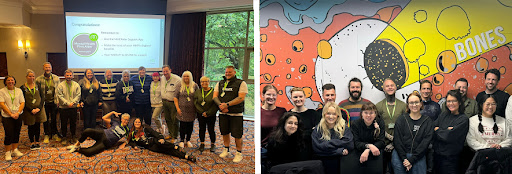
Ryan with his MHFA training groups, 2023/24
Ryan: You know, there are pros and cons [to connecting digitally]. It’s great that we’re able to access relatable, like-minded, people worldwide now. Plus, we might benefit from that anonymity [being online can provide].
Alcoholics Anonymous, who I think have been going since 1935, they’ve thrived in that space — of anonymity, of relatability, of who better to help an alcoholic than another alcoholic. But let’s say my nearest AA meeting is 40 miles away and I can’t drive. It’s great that I can go online and find that same space virtually.
But we’re all different. Some people prefer like face-to-face interactions. For that, you get lots of walk and talk groups like Andy's Man Club for men’s mental health specifically.
So, I think it’s a nice option [to go online]. It opens things up to a lot more people without the logistical or geographical boundaries.
Ryan: I do. Unfortunately, it’s just down to what we happen to come across online. Sadly, there are groups out there who won’t use this virtual space in a responsible way and that was one of my early experiences with AA.
AA are great by the way! Huge respect to them — they help loads of people and their families. But I fell into an AA group that was very, let me choose my words carefully, very old-fashioned, very cult-like. It was, ‘Our way or no way. We will not sponsor you if you’re taking medication for your mental illness. All your problems are a result directly of alcohol.’ That is completely inaccurate, or inaccurate for me anyway… I was eight months sober when I got sectioned.
But since then, I’ve found some great groups - some kind, forward thinking, progressive ones. So, yes, sadly there are groups out there who might attach to someone vulnerable.
Ryan: Well, now I can share that experience and hopefully help others avoid the same thing happening to them. If it doesn’t feel right for you, don’t force it. Look around and find spaces that do feel right, that are kind and non-judgemental. No one human being on the planet has got the answer for you [so be wary of people who say they do]. There’s lots of different approaches to this stuff — not one way. Trust that intuition.
Ryan: I think it was gradual. Back in the day when I first started to struggle… because I didn’t get diagnosed with mental illness until age 35, after doing the Mental Health First Aid course. That gave me the knowledge and awareness to go, ‘I think I’ve got OCD. I’m going to look into that.’
But prior to the course, I didn’t know what I was feeling, what I was thinking, it was confusing. You need that base of knowledge to know where to start and, through that, you develop the ability to communicate better. My only way of communicating way back was through methods of self-harm; trying to get that inner scream out and process my emotions.
I also gained the courage to reach back out [to my friends and family] in this process — because some of my early attempts [to talk about my mental illness] were shut down or someone would say something that made me feel worse.
Ryan: I think it’s the world’s attitude that’s changed. Back then when you tried to communicate, people would just become frustrated because they didn’t understand. They wanted to take the pain away and fix it, and when I kept going back to saying, “I’m thinking this, I’m feeling this, I’m doing this,” people just became exasperated with me.
Whereas now, we know these kinds of conversations don’t require anyone to ‘fix it,’ but to listen well and to signpost (if appropriate) all the great mental health resources out there.
Ryan: Keep it comfortable and natural. You know, we don’t have to worry about changing what we would usually do. We don’t have to sit in a room across from each other, attentively staring into one another’s eyes, ‘Right, tell me about your feelings.’
It can be inherently hard to have these conversations. We [men] have often still got that thing in us that’s like, ‘this doesn’t quite feel right or natural.’ So, just do what you normally do. Whether you play golf, football, go for a beer, go to the coffee shop, walk, whatever, and just bring it up as a natural part the conversation.
Plus, identifying out of all your friends, who would understand this the most? Is there someone in your group that’s gone through something similar? Or perhaps their partner or a parent has? Because, I think, when they have, they’ve got an extra couple of percent empathy. And then, just be honest, lower the mask a little, offer some vulnerability. You want to share a bit with each other, don’t just make it about one person. Let’s explore this together.
But I know it can be a hard thing to do, especially if someone’s previous experience of speaking up has been a negative one.
Ryan: I think your circle gets smaller as you get older because we’re all so busy. And I don’t think it’s necessarily a bad thing. You know, my circle’s got smaller, but I’m left with a solid core group of friends. But if someone moves away or is so busy they start to not get invited to things, that can be really hard.
 In training, men have come up to me saying they feel isolated, they haven’t got the friends they once had and would like to be able to make new ones — which we know can be difficult as adults. Finding a common interest [is important in developing new friendships]. Things like Andy’s Man Club and Men’s Sheds, where you can rock up and everyone is there for the same reason breaks down a barrier straight away… Older generations who, were taught to get on with it and ‘keep themselves to themselves’, might find groups like these a bit alien, but we can let them know the world’s a different place now and be encouraging. Go meet at this support group. Go try a new interest, some hobby you’ve always been curious about.
In terms of maintaining friendships, I don’t think there’s ever a point you reach where you can’t get in touch with an old friend. I’d always be open to a message from someone. Facebook is good for that. It’s normalised now. We all have busy lives and sometimes we disconnect, but it’s fine to reconnect. And if the person doesn’t reply, so be it, it’s not the right time in their journey. We’ve got to make a bit of an effort to reach out and then other people have got to reach back — we’ll meet each other in the middle.
…
A massive thank you to Ryan for being so open and generous. His insights show us that mental health discussions are not ‘one-size-fits-all’ and that even small steps, like reaching out to one trusted person, can make a meaningful difference to individual mental health.
If your organisation would like to do some work around men’s mental health, please don’t hesitate to reach out to us. Or, if you are looking for some individual support, these hotlines, as well as the CALM website, are great, free, confidential resources that we hope will help you on your journey. 💚


